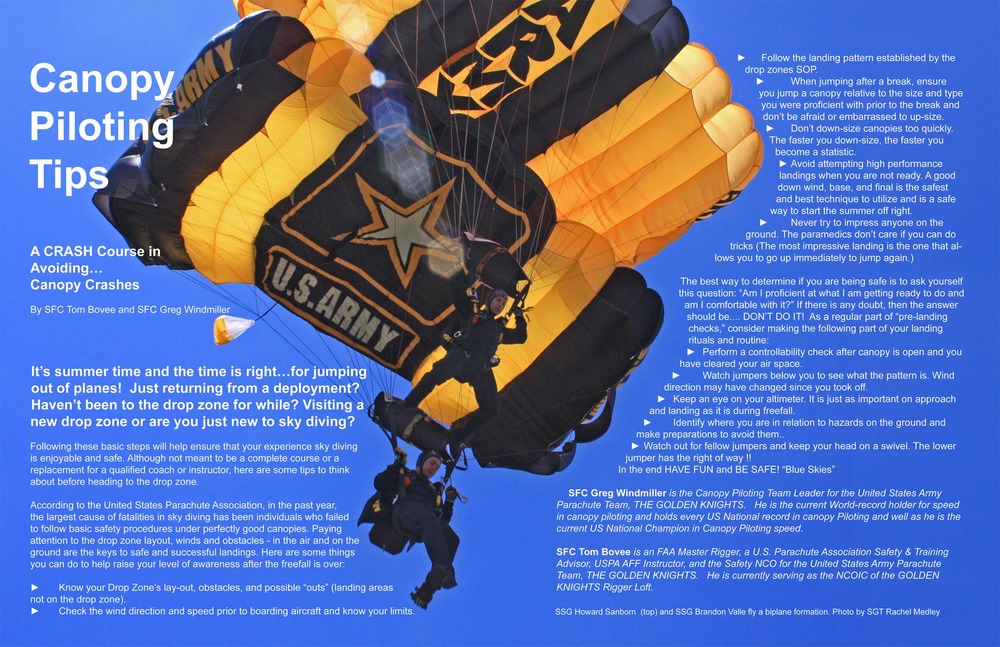
Canopy Piloting Tips: A CRASH Course in Avoiding…Canopy Crashes
By SFC Tom Bovee and SFC Greg Windmiller It’s summer time and the time is right…for jumping out of planes! Just returning from a deployment?Haven’t been to the drop zone for while? Visiting a new drop zone or are you just new to sky diving? Following these basic steps will help ensure that your experience sky diving
is enjoyable and safe. Although not meant to be a complete course or a
replacement for a qualified coach or instructor, here are some tips to think
about before heading to the drop zone. According to the United States Parachute Association, in the past year,
the largest cause of fatalities in sky diving has been individuals who failed
to follow basic safety procedures under perfectly good canopies. Paying
attention to the drop zone layout, winds and obstacles – in the air and on the
ground are the keys to safe and successful landings. Here are some things
you can do to help raise your level of awareness after the freefall is over: ► Know your Drop Zone’s lay-out, obstacles, and possible “outs” (landing areas
not on the drop zone). ► Check the wind direction and speed prior to boarding aircraft and know your limits. ► Follow the landing pattern established by the
drop zones SOP. ► When jumping after a break, ensure you jump a canopy relative to the size and type you were proficient with prior to the break and don’t be afraid or embarrassed to up-size. ► Don’t down-size canopies too quickly. The faster you down-size, the faster you
become a statistic. ► Avoid attempting high performance landings when you are not ready. A good
down wind, base, and final is the safest and best technique to utilize and is a safe way to start the summer off right. ► Never try to impress anyone on the ground. The paramedics don’t care if you can do tricks (The most impressive landing is the one that allows you to go up immediately to jump again.) The best way to determine if you are being safe is to ask yourself this question:
“Am I proficient at what I am getting ready to do and am I comfortable with it?” If there is any doubt, then the answer should be…. DON’T DO IT! As a regular part of “pre-landing checks,” consider making the following part of your landing rituals and routine: ► Perform a controllability check after canopy is open and you have cleared your air space. ► Watch jumpers below you to see what the pattern is. Wind direction may have changed since you took off. ► Keep an eye on your altimeter. It is just as important on approach and landing as it is during freefall. ► Identify where you are in relation to hazards on the ground and make preparations to avoid them. ► Watch out for fellow jumpers and keep your head on a swivel. The lower
jumper has the right of way !! In the end HAVE FUN and BE SAFE! “Blue Skies” SFC Greg Windmiller is the Canopy Piloting Team Leader for the United States Army
Parachute Team, THE GOLDEN KNIGHTS. He is the current World-record holder for speed in canopy piloting and holds every US National record in canopy Piloting and well as he is the current US National Champion in Canopy Piloting speed. SFC Tom Bovee is an FAA Master Rigger, a U.S. Parachute Association Safety & Training Advisor, USPA AFF Instructor, and the Safety NCO for the United States Army Parachute Team, THE GOLDEN KNIGHTS. He is currently serving as the NCOIC of the GOLDEN KNIGHTS Rigger Loft. PHOTO: SSG Howard Sanborn (top) and SSG Brandon Valle fly a biplane formation. Photo by SGT Rachel Medley

 GoArmy.com
 Golden Knights on Facebook
 Golden Knights on Flickr
 Golden Knights on Twitter
 Golden Knights on YouTube
 Official Team Website

{ 1 comment }
I noticed on sundays show in Cape on the final jump one of the gold team members cut his shoot away and had to use his white auxiliary shoot. Nothing was mentioned. How frequently does some thing like that occur?
Comments on this entry are closed.